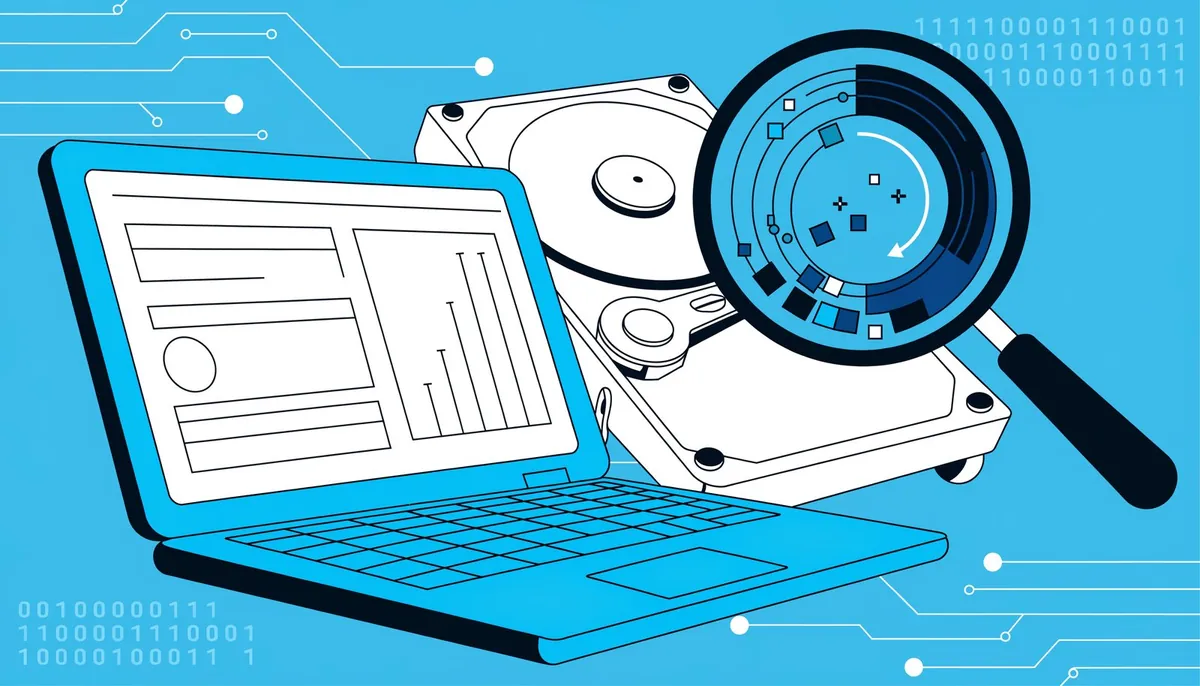
The moment a hard drive no longer starts or a USB stick suddenly reports “not formatted” is one of the most unpleasant experiences in everyday digital life. The last ten years of family photos, the accounts for the current financial year, a thesis just before the deadline – in seconds, everything seems lost. The good news: in the vast majority of cases the data isn't really gone, it just can't be reached any more. The bad news: what you do in the first minutes after the failure often decides whether recovery is still possible at all.
In this guide we explain how logical and physical data recovery differ, when a clean room is actually necessary, what separates reputable providers from dubious ones – and why people in Vaihingen an der Enz and the surrounding district are much faster and better off with a local point of contact than with a mail-in service somewhere across Germany.
Why data gets “lost” in the first place
Before we get to recovery, it's worth looking at the causes. They can be roughly divided into two camps, and it is exactly this distinction that later determines the method:
Logical errors affect the data structure, not the hardware. The storage medium itself works perfectly, but the file system is damaged, a partition table is destroyed, files have been accidentally deleted or formatted, or a virus or ransomware has encrypted or renamed data. The hard drive or SSD spins, is recognised by the system, but returns wrong content or none at all.
Physical errors affect the hardware itself. A read/write head of a classic hard drive (HDD) has touched the spinning magnetic platter (“head crash”), a motor no longer spins up, the circuit board (PCB) has short-circuited after a power cut or lightning strike, or in SSDs a memory chip or controller has failed. No software in the world helps here – the medium has to be opened, repaired or read out surgically.
The catch: to a layperson, both cases often look identical. “The hard drive is no longer recognised” can mean either. That is exactly why a proper diagnosis is the first and most important step – and exactly why we at Hasi Elektronic offer a free initial diagnosis before costs are even discussed.
Logical data recovery: the more common and cheaper case
Around 70 to 80 per cent of all data loss cases that reach us in Vaihingen an der Enz are logical in nature. That's the good news, because logical recoveries are generally faster, cheaper and have a higher success rate than physical interventions.
Typical logical scenarios
- Accidental deletion: a file or an entire folder was deleted and the recycle bin emptied. As long as the storage space hasn't been overwritten, the data is usually still physically there – only the reference to it is missing.
- Formatting: a partition was formatted by mistake, often when setting up a computer again or when connecting an external drive to the wrong device.
- Damaged file system: after a USB stick was removed without being ejected or after a system crash, Windows suddenly reports “You need to format the disk”.
- Ransomware encryption: malware encrypts files and demands a ransom. Data recovery in the classic sense is often not possible here, but shadow copies (Volume Shadow Copies) or existing backups can save what can be saved.
- RAID or NAS errors: a drive in a RAID array fails, the configuration is lost, or a NAS firmware causes problems during an update.
How recovery works technically
For logical cases, we first create a sector-by-sector image of the affected drive – an exact copy that we work with, without putting any further strain on the original. That is the most important principle of professional data recovery: never experiment directly on the original medium. Every write operation on a damaged hard drive can irreversibly overwrite data.
Specialised tools are then used on this image to reconstruct file systems, restore deleted directory entries and recognise and extract files by their characteristic headers (signatures), even when the original folder structure no longer exists (“file carving”). Depending on the fault, this takes between a few hours and two to three working days.
Costs: with us, logical data recovery is typically charged at a fixed price rather than an unclear hourly rate – transparently calculated according to effort and storage size, not according to how desperate the customer is. Talk to us for a concrete quote for your case; after the free diagnosis we'll tell you honestly whether recovery is worthwhile.
Physical data recovery: when the clean room comes into play
Physical defects are much rarer but technically more demanding. Here, as a local IT service provider, our options end at a certain point – and we tell our customers that honestly instead of raising false expectations.
When a clean room becomes necessary
Inside, a hard drive is a precision instrument: the read/write head floats only a few nanometres above the spinning magnetic platter – thousands of times thinner than a human hair. A single speck of dust, a fingerprint or a draught can irreparably damage the platter surface once the housing is open. That's why hard drives with mechanical defects may only be opened in an ISO-certified clean room environment (clean room class 5 or better).
Typical signs of a clean room case:
- Clicking, clacking or grinding noises when switching on (“clicking hard drive”)
- The hard drive no longer spins up, no motor noise
- The hard drive has been dropped or exposed to water or fire
- A strong smell of burnt electronics
- The hard drive is no longer recognised in the BIOS/UEFI at all
Our clear recommendation in these cases: switch the device off immediately, don't try to start it again (every further attempt can increase the damage), and contact us. We diagnose on site whether there is a physical defect and, if necessary, refer you to specialised clean room labs with a proven track record – transparently, without a mark-up, and with a realistic cost estimate in advance. Depending on the damage and storage capacity, clean room recoveries are in a significantly higher price range than logical cases; everyone should be clear about that from the start, before hopes are raised that the costs don't justify in the end.
SSDs are a different matter
Important to know: modern SSDs have no moving parts and therefore no classic “head crash”. Physical SSD defects usually affect the controller chip or the memory modules (NAND flash) themselves, for example after a power cut, a faulty power supply or overheating. Recovery here is done by reading the memory chips directly with special lab hardware – no clean room is needed, but the technology is different and likewise only available in specialised labs.
The first 15 minutes are decisive
Whether logical or physical – the biggest mistakes happen before a specialist is even called in. Here are the most important rules we give every customer:
- Switch off immediately as soon as data loss is noticed. Any further use – even just to “try again” – increases the risk of data being overwritten.
- Don't reinstall or format, even if Windows suggests it. This is the most common reason why a solvable case becomes a hopeless one.
- Don't install recovery software on the affected drive itself. If a recovery program is downloaded onto exactly the drive from which data is to be recovered, the installation may overwrite exactly the areas that are supposed to be recovered.
- If there are unusual noises: don't start the device again. Every start attempt with a mechanical defect can scratch the platter surface further and reduce the chances of success.
- Don't rebuild a RAID/NAS yourself or swap drives before the order and configuration have been documented – an incorrectly restored RAID can destroy existing data for good.
What separates reputable data recovery from dubious offers
Unfortunately, the data recovery market is also a market for scaremongering. Anyone searching online for “data recovery near me” or “hard drive broken help” will come across providers of very varying reputability. A few warning signs:
- Flat fixed prices without a diagnosis: reputable providers only tell you what is possible and what it costs after an examination – not beforehand on the phone.
- “No data, no charge” without the small print: sounds good, but check what is defined as “success”. If 2 out of 500 photos are recovered, that's technically a success, but possibly worthless to you.
- No cost estimate before work begins: anyone who simply gets started without your approval risks an unpleasant surprise on the invoice.
- Data protection: your data – photos, business documents, customer data – passes through other people's hands. Ask how the data is handled after recovery and whether a confidentiality agreement is possible. Especially for businesses with GDPR obligations, this isn't a nice-to-have but a must.
Prevention is always cheaper than recovery
However well a recovery may go – the cheapest data recovery is the one that's never needed. A well-thought-out backup concept based on the 3-2-1 rule (three copies of the data, on two different types of media, one of them stored in a separate location, for example in the cloud or with us) prevents most of the horror scenarios described above from the outset. For small businesses in the region – trades businesses, practices, law firms – we offer automated backup solutions as part of our Digital Caretaker (Digitaler Hausmeister) service, so that this call with a trembling voice at the other end never has to happen.
How we work at Hasi Elektronic
- Free initial diagnosis on site in Vaihingen an der Enz or remotely, where possible.
- An honest assessment: we say clearly whether it's a logical or physical case and how realistic recovery is – even if the answer is sometimes “probably not”.
- A transparent quote before the actual work begins – a fixed price instead of an hourly-rate surprise.
- For physical cases: referral to vetted clean room partners with a realistic success rate and costs that we communicate in advance.
- After recovery: handover of the data on a new, encrypted drive – on request with our own HasiSafe Stick (AES-256 encryption), so that it doesn't happen to you again.
Why a local point of contact makes the difference
Many nationwide data recovery chains work the same way: you send in the device by courier, wait days for a cost estimate and have no control at all over the medium with your most sensitive data during that time. For a simple logical case – deleted folders, a formatted partition, a damaged file system – that is unnecessarily complicated and unnecessarily expensive, because the price usually includes a shipping and administration surcharge.
With us in Vaihingen an der Enz, you bring the device in person, watch the diagnosis or collect it after we've talked, and have a contact person you can still reach after the recovery – for example if you want to set up the right backup concept straight away so that the next failure no longer causes a scare. Only in genuine clean room cases does the medium actually travel to a specialised lab – and even then, as your local contact, we keep track of status, costs and schedule instead of leaving you alone with an anonymous hotline.
Costs at a glance
Quoting flat prices across all cases would be dubious – storage capacity, type of damage and effort differ too much. As a rough guide to what customers can realistically expect:
- Logical recovery, small scope (individual deleted files, small USB stick or SD card): usually the cheapest case, often done within a day.
- Logical recovery, larger scope (formatted or damaged hard drive/SSD, several hundred GB to a few TB): medium effort, one to three working days.
- RAID or NAS recovery: more effort due to several drives and a complex configuration, correspondingly higher in price, but still in the logical range as long as no drive is mechanically defective.
- Physical recovery in a clean room: the most expensive segment, as specialised lab equipment and trained staff are needed – costs vary considerably depending on the lab and the type of damage.
We always give you the exact price for your specific case only after the free diagnosis, in writing and in plain language, before anything is started on the actual recovery.
Frequently asked questions
Can't I just try it myself with free software? For smaller, non-critical cases (an accidentally deleted holiday photo, if nothing else has been saved to the medium since), there's little against trying it carefully yourself – as long as the recovery software is installed on a different drive. With business-critical data, unusual noises or if the first attempt has already failed, we strongly advise against it: every failed attempt reduces the chances of a professional recovery afterwards.
How long does data recovery take? Logical cases are often done within one to three working days. Clean room cases can take several weeks, depending on the lab's workload and the complexity of the damage. We'll tell you the realistic time frame at the start.
What happens if nothing at all can be recovered? That happens, especially with very severe physical damage or if a medium has already been overwritten several times. In this case there are no costs for the actual recovery – only a fair diagnosis fee, which we communicate transparently in advance, not only on the final invoice.
Is my data safe during recovery? Yes. We treat every medium and all the information on it confidentially and only return data to you as the client. On request we sign a separate confidentiality agreement, especially for business customers with personal or particularly sensitive data.
Conclusion
The difference between logical and physical data recovery is ultimately the difference between a software problem and a hardware problem – but for a layperson it usually isn't obvious at first glance. That's exactly why every reputable data recovery begins with an honest diagnosis, not a price tag. Act quickly but thoughtfully: switch off the device, don't try anything else, contact a specialist. In most cases the chances are considerably better than you think in that first moment of shock.
If a hard drive is clicking right now, a USB stick reports “not formatted” or an important file has suddenly disappeared: switch off the device, don't touch it any further, and call us. The first minutes are decisive – and an honest diagnosis is free with us.
Contact: +49 7042 16391 · [email protected] · Grabenstraße 18, 71665 Vaihingen an der Enz, Germany (near Stuttgart). We are happy to help in English.