A USB stick costs a few euros and fits in any trouser pocket – and that is exactly its biggest security problem. It gets left behind, lent out, forgotten in the car or falls out of a jacket pocket. As long as it holds holiday photos, that is annoying. But if it holds customer data, invoices, contracts, patient records or login details, a lost stick quickly becomes a serious data protection problem – with possible legal and financial consequences, especially for small businesses, practices and law or tax offices in the region.
In this guide we explain what distinguishes an encrypted USB stick like our HasiSafe Stick from an ordinary storage device, how the encryption works technically, which buying criteria really matter – and who the investment pays off for in practice.
Why ordinary USB sticks are an underestimated risk
A standard USB stick stores data completely unprotected. Anyone who gets hold of it – through loss, theft or simply because it was left on the desk – can open its contents on any computer, with no password and no hurdle. There is no built-in protection mechanism that distinguishes between the rightful owner and a finder.
In practice we see this more often than you might think: a stick with accounting records left on the passenger seat after a customer appointment. A stick with patient data that accidentally ends up in the wrong bag along with the laptop backpack. A stick with site plans and cost calculations that disappears in a file box during an office move. In none of these cases was there any bad intent – but in every case the data was freely readable for any finder.
How does hardware encryption actually work?
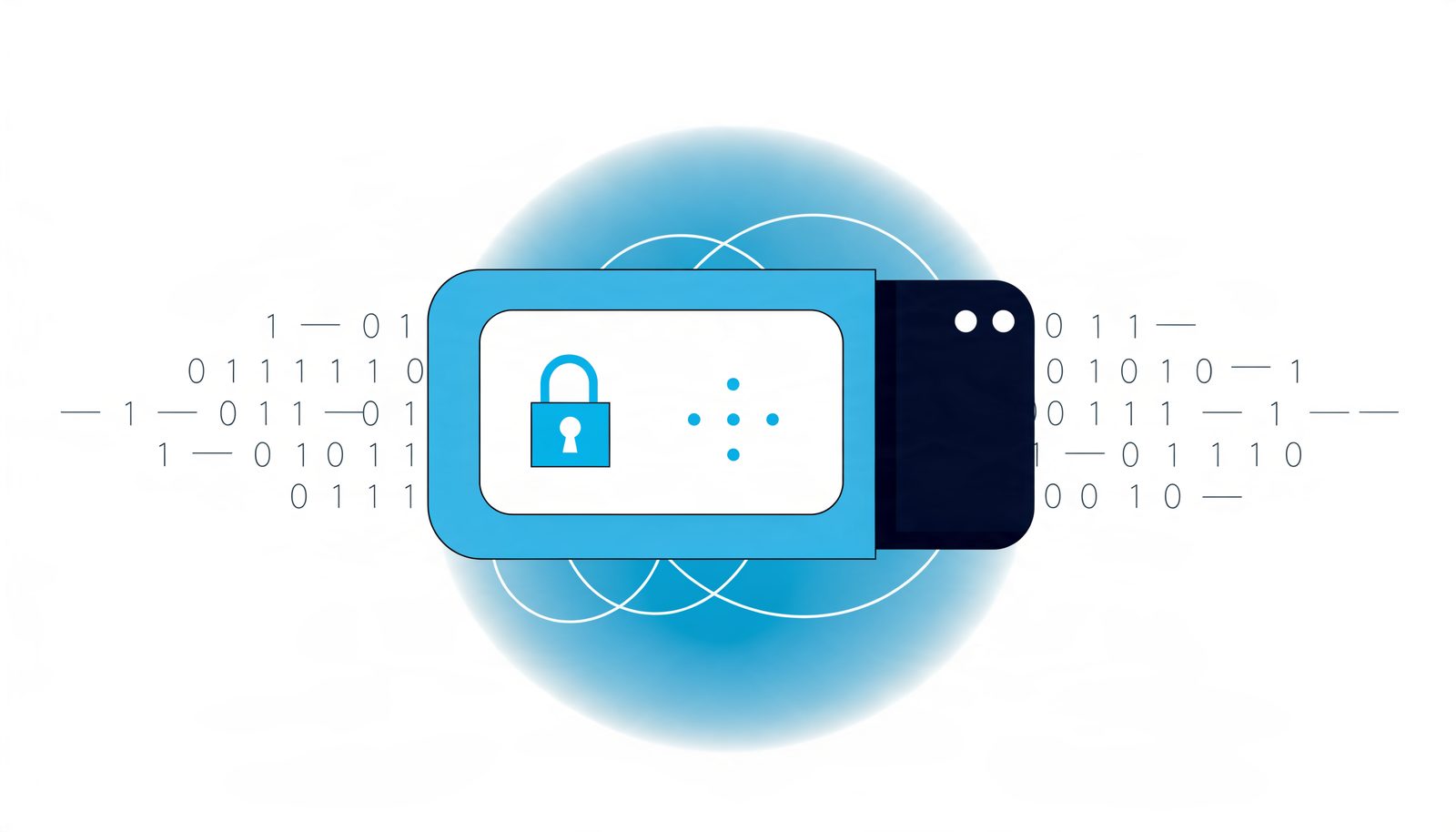
With a hardware-encrypted stick like the HasiSafe Stick, a dedicated encryption chip sits directly in the device. All data is encrypted automatically and without any action by the user using the AES-256 encryption standard before it is even written to the memory chip – and decrypted again accordingly when it is read. AES-256 is currently considered practically impossible to crack by brute-force attacks and is used, among others, by authorities and banks for highly sensitive data.
The decisive difference from software encryption: the key never leaves the chip on the stick itself. Without the correct PIN – usually entered on a small keypad directly on the device or via a companion app – the storage area remains invisible to any connected device, as if the stick were empty or not formatted at all. If the wrong PIN is entered several times, many models automatically wipe themselves after a certain number of failed attempts – additional protection against systematic guessing.
Hardware vs. software encryption: the difference in practice
Windows comes with its own software encryption for USB sticks, BitLocker To Go, which in principle also offers good protection. The decisive difference lies in practicality: BitLocker To Go usually requires a particular Windows edition (mostly Pro or Enterprise), has to be activated and configured manually before use, and a password entered on someone else's computer could theoretically be captured by keyloggers or malware on that computer.
A hardware-encrypted stick, on the other hand, works independently of the operating system – it can be used on Windows, Mac or Linux computers alike without installing any software first. The PIN is entered directly on the device, not via the keyboard of the connected computer, which significantly reduces the risk of it being captured. For professional use – such as exchanging sensitive data with changing customer or practice computers – that is a noticeable practical advantage.
The HasiSafe Stick in detail
Our HasiSafe Stick was developed specifically for the needs of small businesses, practices and private users in the region who need to transport sensitive data securely but without complication:
AES-256 hardware encryption – the industry standard, with no compromises on security.
Operating-system independent – works on any computer with a USB port, without installing drivers.
PIN protection directly on the device – the PIN is not entered via the keyboard of the connected PC.
Self-wipe function after repeated failed attempts – protection against systematic guessing of the PIN.
Robust housing, designed for daily transport in a toolbox, briefcase or glove compartment.
Free initial advice on the right storage capacity for your specific use case – not everyone needs the same size.
Who does an encrypted stick really pay off for?
Trade businesses that transport building plans, cost calculations or customer data between the office and the construction site – often on the move, often under time pressure, where a stick can easily end up in the wrong bag.
Medical practices, physiotherapists and other healthcare professions that need to exchange patient data – here, in addition to the GDPR, medical confidentiality often applies, which raises the need for protection even further.
Tax advisers, bookkeepers and law firms that regularly exchange sensitive financial or client data with customers, often digitised from paper and handed over on a stick.
Small and medium-sized businesses with several locations that move data between offices without relying on a permanent cloud connection.
Private individuals who want to keep particularly sensitive documents – contracts, certificates, ID copies, family photos – safe and offline, independent of cloud providers and their privacy terms.
Anyone who only transports non-critical data that is publicly available anyway does not need an encrypted stick – the investment simply is not worth it there. We are happy to give you an honest assessment of whether your use case qualifies during a consultation.
Buying criteria: what to look for in an encrypted stick
Encryption standard. Look for genuine AES-256 hardware encryption, not marketing terms like "secure" without concrete technical details.
Certification. Models with recognised security certifications (e.g. FIPS 140-2/3 in professional environments) offer additional, externally tested security – relevant above all for businesses with increased protection needs.
Operating-system independence. Check whether the stick really works on any system without installing software, or whether a particular Windows edition or app installation is required.
Self-wipe function and PIN entry on the device. These two features distinguish high-quality hardware solutions from simpler software-only approaches.
Capacity matched to the use case. The largest capacity is not automatically the best choice – anyone who regularly exchanges small amounts of data does not need an oversized (and more expensive) stick.
Warranty and support. Especially with a device that is meant to protect sensitive data, it pays to choose a provider who can actually be reached with questions or in the event of a defect – not just an anonymous online marketplace seller.
Common misconceptions about encrypted USB sticks
"A password on the PC is enough." A Windows or Mac login password only protects access to the switched-on, logged-in device – if the stick is connected to another computer or the storage medium is read directly, that password does not help. Only encryption that works directly on the storage device itself protects you regardless of which device the stick ends up in.
"Encrypted sticks are complicated to use." With modern hardware solutions like the HasiSafe Stick, the extra effort compared with a normal stick is limited to entering the PIN when plugging it in – a process that takes a few seconds and, after a short time, feels as natural as unlocking a smartphone.
"This only concerns large companies with many employees." In fact, small businesses and single-doctor practices are particularly at risk, because there is often no IT department that could react quickly or limit the damage in an emergency. A single lost stick can weigh more heavily economically on a small business than on a large company with corresponding reserves.
"An encrypted ZIP file on a normal stick is just as secure." A password-protected ZIP file offers a certain basic protection, but may be easier to attack with freely available tools than dedicated AES-256 hardware encryption, and it also only protects that one file – not unencrypted files that were accidentally stored on the same stick as well.
HasiSafe Stick vs. common brand-name sticks
There are certainly other manufacturers of encrypted USB sticks on the market, often from international electronics retail. The difference rarely lies in the encryption technology itself – AES-256 is an open, established standard – but in the advice, support and fit for regional small and medium-sized businesses. With us, you do not receive the stick anonymously by post, but with a personal assessment of which capacity and features actually suit your use case, a short on-site introduction, and a contact person who can still be reached months later if questions come up or the stick needs to be replaced. For businesses that already use IT services from us, introducing encrypted sticks can also be combined directly with a short staff training on handling mobile storage devices safely.
GDPR: what small businesses should know
For businesses that process personal data – and that applies to practically every business with customer, patient or employee data – Art. 32 of the GDPR requires appropriate technical and organisational measures to protect this data. An unencrypted USB stick with customer data in plain text generally does not meet this standard. If such a stick is lost, it may in individual cases constitute a personal data breach that must be reported under Art. 33 GDPR – with the corresponding effort, possible fines and the associated loss of trust among customers or patients.
A hardware-encrypted stick reduces this risk considerably: if the device is lost, the data remains unreadable for the finder – an important difference in an emergency, also with regard to the reporting obligation, because actual access to personal data by unauthorised persons can then generally not be assumed. This assessment does not replace individual legal advice, but it is an important argument for why the investment often pays off quickly for businesses.
An everyday example
A trade business from the region regularly passes measurements, photos and cost calculations between the construction site, the office and an external structural engineer. Before the switch, this data went via an ordinary USB stick that changed hands several times between different people – without anyone knowing exactly where it was when it was briefly needed. After switching to a HasiSafe Stick with an individual PIN per user, data exchange continues just as easily – with the difference that a lost or temporarily missing stick no longer poses a security risk, as long as the PIN is not known.
Frequently asked questions
Isn't an encrypted stick just a normal stick at a higher price?
No – the price difference comes from the additional encryption chip and the associated hardware, not from marketing. Technically, the way it works is fundamentally different from an ordinary stick.
Can I forget the PIN and then no longer get to my data?
Yes, that is a real trade-off between security and convenience – without the correct PIN the data is deliberately inaccessible, even for us. We therefore recommend storing the PIN in a secure, separate place (not on the stick itself) and additionally backing up important data regularly.
Wouldn't a cloud solution do instead of a USB stick?
Cloud storage and an encrypted USB stick are not mutually exclusive; they complement each other. A stick offers offline availability without an internet connection and direct control without third-party servers, and for very sensitive data it is often the preferred choice of practices and law firms that, for data protection reasons, are reluctant to rely on external cloud providers.
How long does a hardware-encrypted stick last?
With good workmanship, the lifespan matches that of normal high-quality USB sticks – the additional electronics for encryption have hardly any effect on durability in practice.
What capacity do I need for my business?
That depends on the use case – for exchanging individual documents, smaller capacities are often enough; for photo and plan documentation, larger ones. We advise you on this free of charge and without obligation.
Is the HasiSafe Stick also available for private individuals, not just businesses?
Yes, explicitly – many of our customers use it privately for particularly sensitive documents such as contracts, ID copies or important digitised documents.
What happens if the stick is physically damaged – is the data then completely lost?
That depends on the extent of the damage. With purely external damage to the housing, the data usually remains accessible. If the memory chip itself is defective, data recovery is technically more demanding than with an unencrypted stick, because the encryption chip is part of the recovery process – we check what is possible on a case-by-case basis.
Can I set up several users with different PINs on the same stick?
With certain models, yes – which is particularly suitable for businesses where several employees use the same stick but each should have their own access credentials. We are happy to advise you on which model supports this function.
Conclusion
An encrypted USB stick is not an exaggerated precaution; for anyone who regularly carries sensitive data around, it is now an obvious building block of data security – comparable to a bicycle lock: you only notice its value at the moment you would have needed it. Especially for trade businesses, practices and law or tax offices in the region, the investment is manageable, but the protection in an emergency is considerable.
Would you like to know whether, and which, HasiSafe Stick suits your use case? Get in touch – we advise you without obligation and without sales pressure.
Contact: +49 7042 16391 · [email protected] · Grabenstraße 18, 71665 Vaihingen an der Enz, Germany (near Stuttgart). We are happy to help in English.