
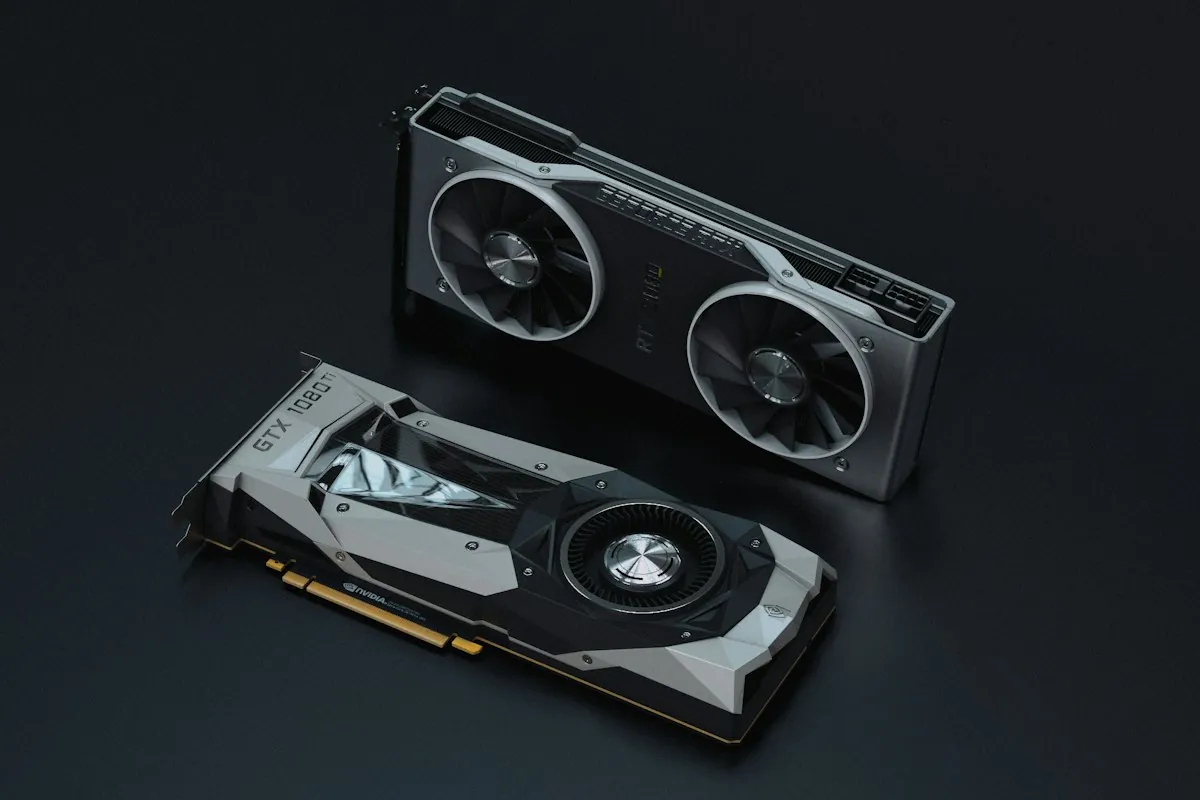
GPU, graphics card, dedicated graphics — these terms are thrown around everywhere. But what does it actually mean for you? And when does buying a separate graphics card make sense?
What Is a Graphics Card?
A graphics card (GPU = Graphics Processing Unit) is a specialized chip that calculates images. Every PC has one — either built into the processor (integrated graphics) or as a separate card (dedicated graphics).
Integrated Graphics: When Is It Enough?
Modern processors from Intel (Intel Iris Xe) and AMD (Radeon Graphics) have surprisingly capable integrated graphics. They're perfectly fine for: Office work, web browsing, video streaming (Netflix, YouTube up to 4K), photo editing (light), video calls.
When Do You Need a Dedicated GPU?
- 🎮 Gaming: Modern games require a dedicated GPU. Without one: unplayable at decent settings.
- 🎬 Video editing: 4K videos, effects, rendering — a GPU accelerates this enormously.
- 🎨 3D design: CAD, Blender, 3ds Max — absolutely requires a GPU.
- 🤖 AI/Machine Learning: Training neural networks runs primarily on the GPU.
GPU Recommendations 2026
Gaming Entry Level (1080p): Nvidia RTX 4060 (~€280) · AMD RX 7600 (~€250)
Gaming Mid-Range (1440p): Nvidia RTX 4070 (~€550) · AMD RX 7700 XT (~€400)
Workstation: Nvidia RTX 4070 Ti or higher
Our Honest Advice
Don't buy a GPU if: you only do office work, browsing and streaming. Your integrated graphics handles this perfectly. Buy a GPU if: you game, do video editing, or work with 3D content.
Questions about upgrading your PC? We advise you honestly: 07042 / 16391